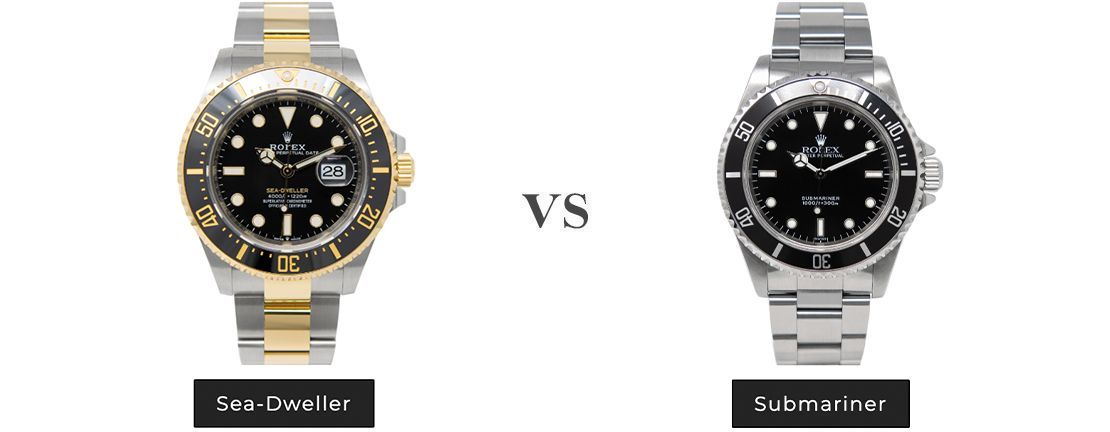
The Rolex Submariner and Rolex Sea-Dweller are two of the most legendary dive watches in the world, each with a devoted fan base. At first glance, they share many similarities: the iconic Rolex Oyster case, a unidirectional diver’s bezel, and a classic black dial with luminous markers. However, closer inspection reveals key differences that can influence which one is the right choice for you.
Both models share Rolex’s dive watch DNA, but they cater to different audiences. The Submariner is widely regarded as the quintessential all-purpose luxury sports watch, while the Sea-Dweller is built to satisfy professional divers who need extreme depth capabilities. In this guide, we’ll explore how the two models differ in history, design, technical features, dimensions, and pricing—so you can decide which one is the perfect fit for your wrist.
Brief History of the Submariner & Sea-Dweller
Rolex Submariner
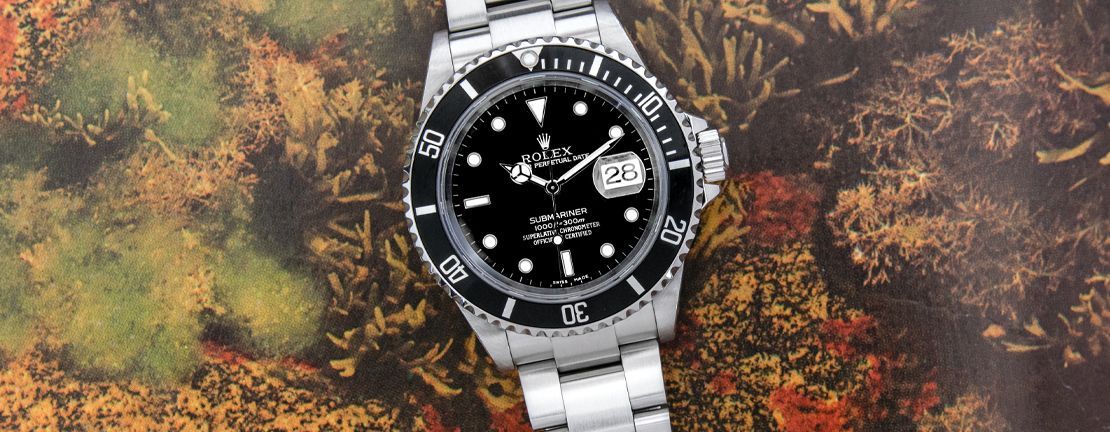
Launched in 1953 at the dawn of recreational scuba diving, the Submariner was the first watch to be water-resistant to 100 meters. It quickly set new standards for dive watches, with its robust build, rotating bezel to track dive time, and highly legible dial. Early models evolved over the decades to include features like a slightly larger 40mm case (with crown guards), a date function with the famous magnifying Cyclops lens, and improved water-resistance that eventually reached 300 meters. Appearances in James Bond films helped cement the Submariner’s status as an icon, and it remains a cornerstone of Rolex’s lineup.

Rolex Sea-Dweller
Introduced in 1967 as a companion to the Submariner, the Sea-Dweller addressed the needs of professional deep-sea saturation divers. Working with commercial diving companies, Rolex developed the helium escape valve to prevent crystals from popping off during decompression. The first Sea-Dweller (Ref. 1665) was rated to 610 meters—double the depth of early Submariners—and featured a thicker case and stronger crystal. By 1978, Rolex doubled the depth rating to 1,220 meters, far surpassing the Submariner’s 300-meter limit. Originally a steel-only, purely utilitarian watch, the Sea-Dweller was briefly discontinued in 2008 but returned in 2014 with modern updates, including a slightly larger 43mm case in 2017 and the addition of the Cyclops lens. Despite these changes, the Sea-Dweller remains the more specialized diver in Rolex’s collection.

Key Differences Between the Rolex Sea-Dweller and Submariner
1. Water Resistance & Depth Rating
The most significant difference between these models is water resistance. The Submariner is rated to 300 meters—more than enough for almost any recreational or professional scuba situation. Very few divers ever approach 300 meters, so the Submariner’s rating is already overkill for most.
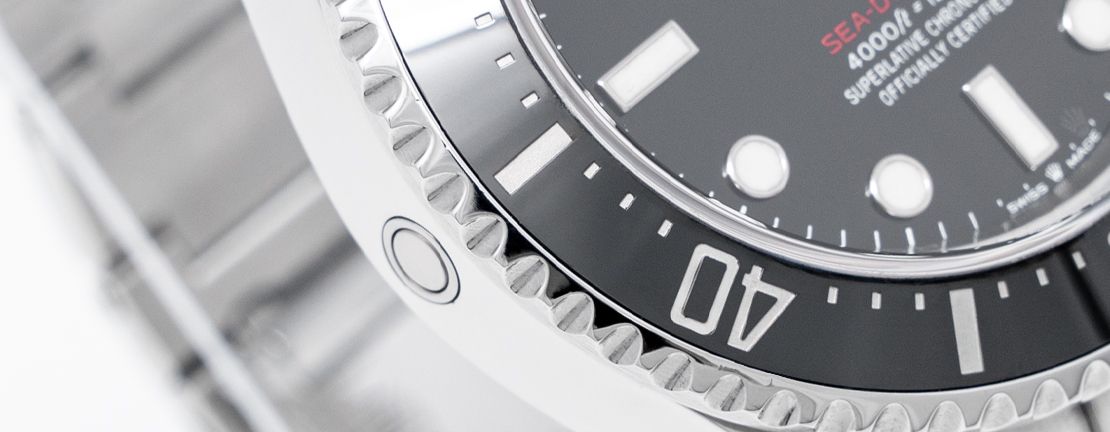
The Sea-Dweller, however, is built for much greater depths. Modern versions are rated to 1,220 meters—over four times the Submariner’s limit. Originally developed for saturation divers, it features a helium escape valve and a thicker case construction. While most wearers won’t come close to these depths, the Sea-Dweller’s high depth rating is a testament to Rolex’s engineering prowess. For anyone who simply wants the peace of mind that comes with extreme capabilities, or actually works at great depths, the Sea-Dweller is the clear winner in this category.
Rolex Deepsea Note
A special variant known as the Rolex Sea-Dweller Deepsea pushes water resistance to 3,900 meters by using an even thicker case with a patented internal ring. It’s truly a niche watch, even bulkier than the standard Sea-Dweller. While the Deepsea is a technological marvel and unless you prefer especially large watches, most people find it impractical for daily wear.
2. Case Thickness & Size
Historically, the Submariner’s 40mm diameter and around 12–13 mm thickness have made it an extremely wearable sports watch. The latest Submariner is officially 41mm but remains relatively slim at about 12.5 mm thick. This moderate size makes it versatile, easy to wear every day, and capable of fitting under a shirt cuff.
The Sea-Dweller, on the other hand, is bigger in both diameter (43mm) and thickness (around 15 mm). That extra bulk is necessary to support its massive depth rating and accommodate the helium escape valve. The greater thickness and additional weight are immediately noticeable on the wrist. For those with smaller wrists or who value a lower profile, the Submariner tends to be more comfortable. The Sea-Dweller’s heft is part of its appeal, but it can be top-heavy and more difficult to slide under tighter sleeves.
3. Design & Aesthetics
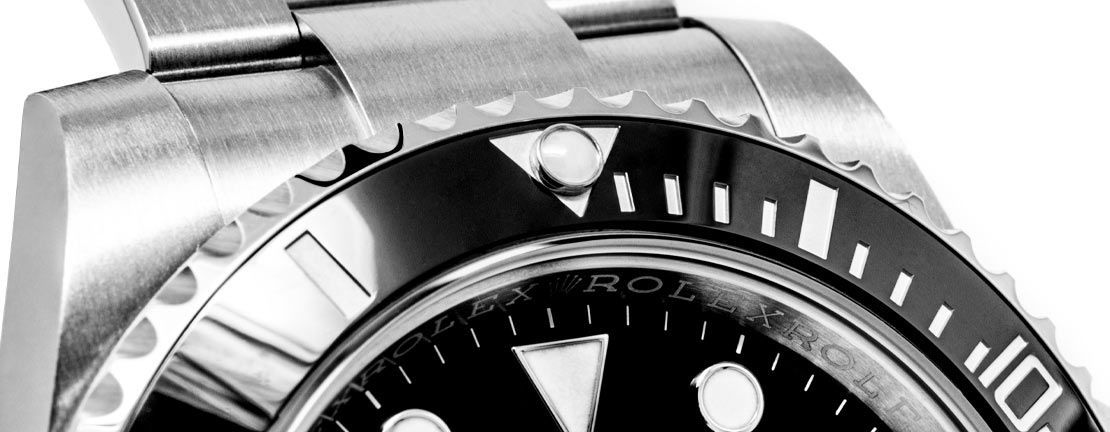
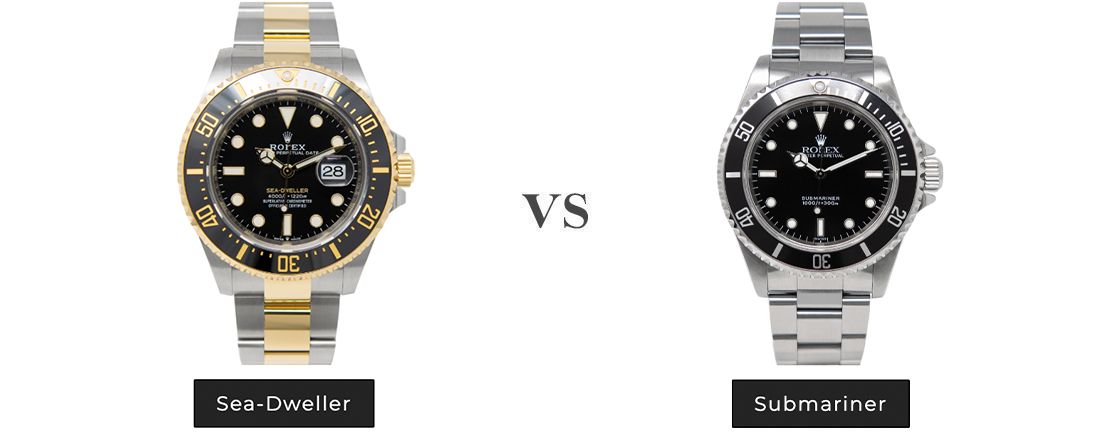
Both the Submariner and the Sea-Dweller share classic Rolex dive elements: large luminescent hour markers, “Mercedes” hands, and a unidirectional ceramic bezel. At a glance, a Sea-Dweller might look like a bigger Submariner, but there are a few distinguishing features:
- Cyclops Lens: Traditionally, the Submariner Date has a Cyclops magnifier above the date window, while older Sea-Dwellers did not (to preserve crystal strength at depth). However, modern Sea-Dwellers now include the Cyclops lens, making the two even more visually similar.
- Helium Escape Valve: This small valve on the case side near 9 o’clock is unique to the Sea-Dweller. It’s subtle, but a sure sign you’re looking at a Sea-Dweller rather than a Submariner.
- Dial Text: The Sea-Dweller tends to have more text on the dial, often including red lettering. The Submariner has simpler white text. Vintage Submariners for a short amount of time also had red lettering.
- Variations: The Submariner line is available in a wider range of configurations (e.g., green bezel, two-tone, solid gold) compared to the Sea-Dweller, which sticks mostly to black dials/bezel in steel or two-tone.
In essence, the Submariner is more recognizable and remains sleeker, while the Sea-Dweller offers a heftier, more utilitarian aesthetic.
4. Movement & Technical Specs
Both watches share Rolex’s latest generation of in-house movements. Modern Submariner Date and Sea-Dweller references use the Caliber 3235 (the Submariner No Date uses Caliber 3230, which is the same base minus the date function). These movements have around a 70-hour power reserve and meet Rolex’s stringent accuracy standards.
Historically, the two models also used similar calibers with small variations. Apart from the helium escape valve in the Sea-Dweller, there is little difference in their overall mechanical functionality; both are highly robust, accurate, and reliable.
5. Wearability & Comfort
How each watch feels on your wrist is often the deciding factor. The Submariner’s slimmer profile makes it one of the most comfortable sports watches available, suitable for daily wear in both casual and more formal settings. It weighs less, making it feel balanced on a variety of wrist sizes.
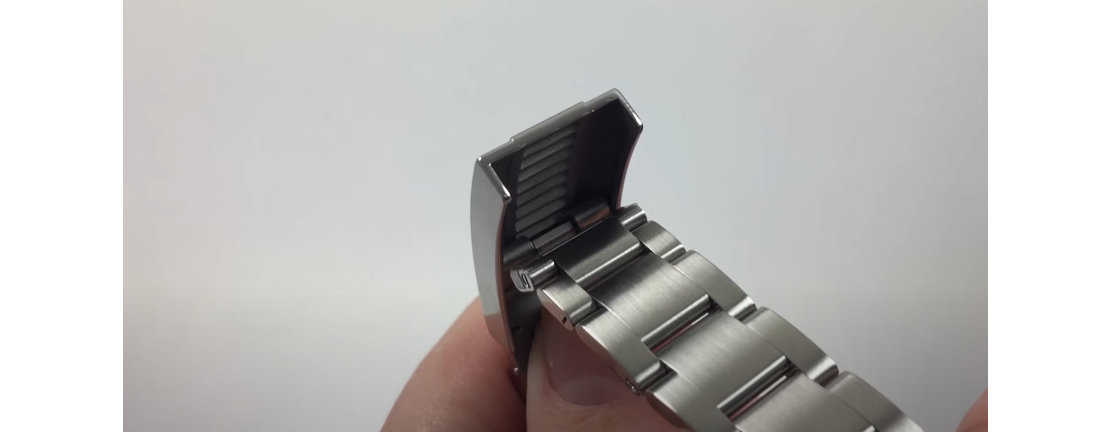
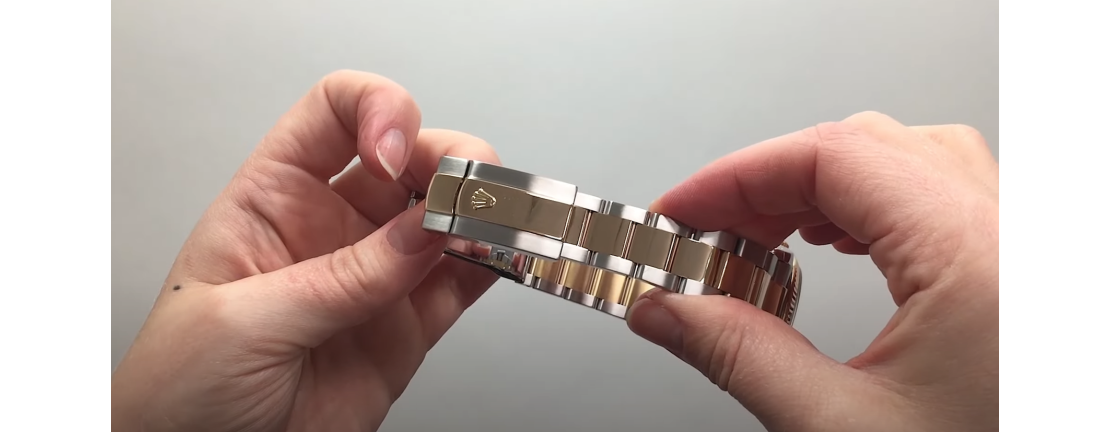
The Sea-Dweller is heavier and taller, which some people find satisfying—there’s a certain reassurance in knowing you have an overbuilt dive watch on your wrist. Others may find this heft overwhelming for everyday use, especially if their wrists measure less than about 6.5 inches. Both models do come with Rolex’s excellent Glidelock clasp for easy micro-adjustments, ensuring a secure and snug fit.
6. Price & Value
Retail prices often show the Sea-Dweller listed higher than the Submariner due to its additional engineering. For example, a stainless steel Submariner Date is typically a few thousand dollars less than a stainless steel Sea-Dweller. Two-tone versions of either watch increase the price, but again, the Sea-Dweller generally costs more.
Both are in high demand and can be difficult to buy at retail without a waiting list. On the secondary market, prices vary based on condition, age, and popularity. The Submariner, being more universally recognized and in extremely high demand, often commands premium prices. The Sea-Dweller is also sought-after but appeals to a more niche audience.
Both models hold their value exceptionally well. Rolex sport watches have a reputation for retaining—or even appreciating—over time. Whether you choose a Submariner or a Sea-Dweller, you’re unlikely to make a bad investment.
Who Should Buy the Sea-Dweller vs. the Submariner?
Why Choose the Submariner
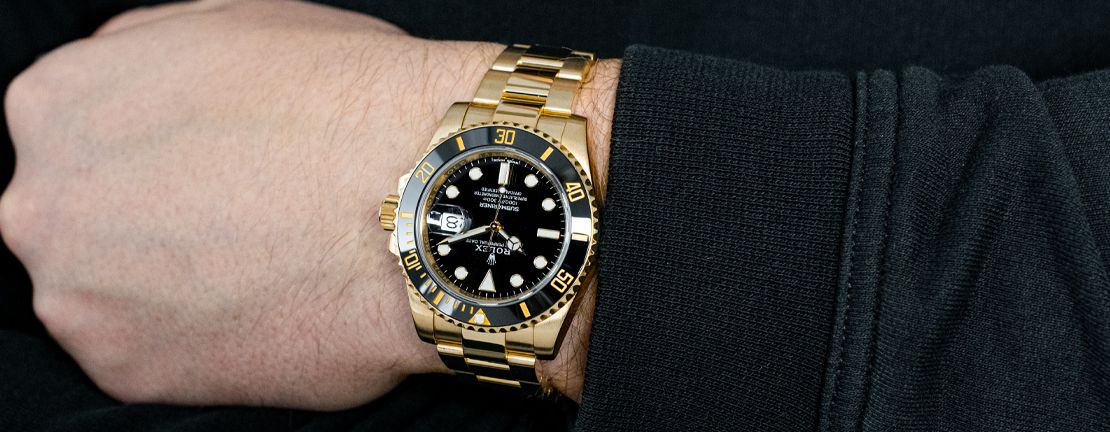
- Iconic Everyday Watch: The Submariner is the epitome of a do-it-all luxury sports watch that can transition effortlessly from the beach to a boardroom.
- Wearability: Offered in both 40mm and 41mm sizes. Slimmer thickness make it comfortable on most wrists, fitting easily under sleeves.
- Historic Status: Its long history and cultural significance (including James Bond associations) make it a must-have for many collectors.
If you want a timeless design, a manageable case size, and a piece of horological history that’s perfect for daily wear, the Submariner is tough to beat.
Why Choose the Sea-Dweller
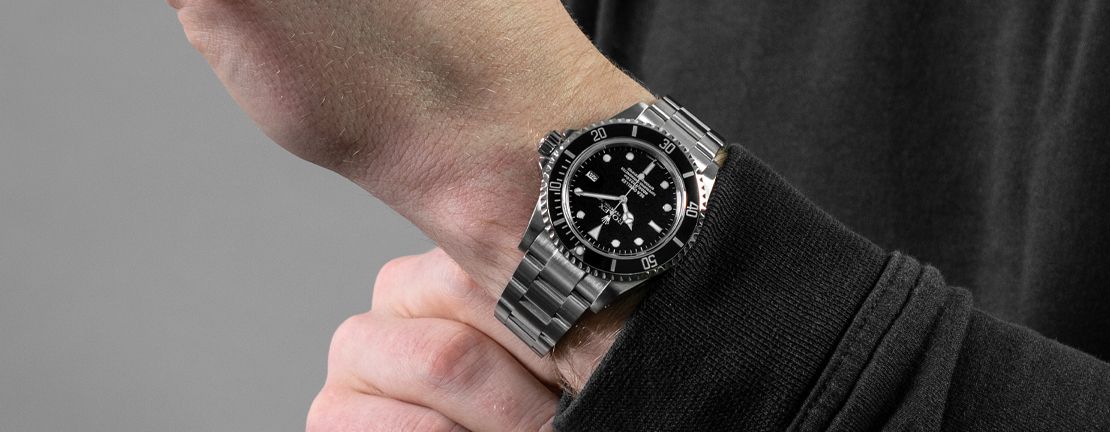
- Extreme Capabilities: With a 1,220m depth rating and a helium escape valve, it’s engineered for professional saturation diving. Even if you never dive that deep, its overbuilt construction is part of its charm.
- Bigger Wrist Presence: Offered in 40mm and 43mm sizes. Thicker case create a more substantial feel, which some wearers prefer.
- Rarity & Heritage: The Sea-Dweller is less common than the Submariner, giving it a distinctive aura. It was born from deep-sea exploration, adding an extra layer of intrigue.
Choose the Sea-Dweller if you have a larger wrist or appreciate the technical achievements that allow for extreme depth ratings. Many also enjoy that the Sea-Dweller stands out a bit more as the “professional’s” dive watch—though be sure you’re comfortable with the added thickness and weight.
Submariner or Sea-Dweller—Which Is Right for You?
Ultimately, the choice hinges on your personal style, how you plan to wear the watch, and whether the technical specs of the Sea-Dweller are worth the extra heft and cost. The Submariner offers 300m of water resistance, a thinner 41mm case, and one of the most iconic designs in watchmaking history. For most buyers, this makes it the perfect all-around dive watch that can handle virtually any situation.
By contrast, the Sea-Dweller delivers a 1,220m depth rating, a larger 43mm build with a helium escape valve, and a professional heritage rooted in commercial diving. It’s the perfect choice for saturation divers or collectors who value exclusivity and the highest possible specs.
Neither model can be called the outright “better” watch. The Submariner is legendary for a reason—it’s recognizable, comfortable, and steeped in history. The Sea-Dweller is the more specialized tool, offering a beefier presence and extraordinary engineering. Both are outstanding dive watches that will retain value over time, thanks to Rolex’s reputation and quality.
In the end, the best way to decide is to try them on. See how the Sea-Dweller’s thickness feels on your wrist and whether the Submariner’s smaller profile appeals to you. Whether you’re an actual diver or just a desk diver, both timepieces represent pinnacle achievements in dive watch design. Whichever you choose, you’ll be wearing a piece of horological history that continues to inspire enthusiasts around the globe.
Happy diving—or desk diving! And if you get the chance to strap on either of these models for a real underwater adventure, you’ll be carrying on the spirit of exploration that made Rolex dive watches famous in the first place.